
-
Welcome to H4O! For a reduced ad experience, please login or register with the forum.
You are using an out of date browser. It may not display this or other websites correctly.
You should upgrade or use an alternative browser.
You should upgrade or use an alternative browser.
H3 Any 5spd clutch h3
- Thread starter 954paulo
- Start date


cbetts
NERD!!!
- Messages
- 3,188
- Location
- Rancho Palos Verdes, CA
I had a shop do mine. I didn't want to try to benchpress the trans and transfer case case in my garage.

4speedfunk
Well-Known Member
- Messages
- 4,250
- Location
- Tardville
Okay...I'll pipe up. I've done a bunch of clutches...closet I got is a ZR2 S-10. All GM clutch swaps are pretty straight forward. Get a clutch kit (disc, plate, throw-out).
Pull both driveshafts.
Unbolt the shifter.
Unbolt the gearbox from the bell housing OR the bell from the engine block (if its all one piece).
Unplug the t-case.
Unbolt the tranny mount.
Slide the tranny/t-case rearward to access the clutch assembly.
You might need a "throw-out bearing release tool"...sort works like a slim-jim does on a locked door.
Pull the plate, disc, and throw-out bearing....toss em.
Pull the flywheel off the crank...take it to a machine shop and get it surface ground and checked for cracks. (look for any blu-ing from heat).
You might want to mark the flywheel (or take a digital pic) so you can be sure to get it back in the correct place (not sure if 3.7L's use a balanced flywheel or not).
Check the pilot bushing for wear. If the truck shuddered at take-offs, this bushing is probably wallowed-out inside. I usually replace the bushing with a roller bearing. (Moroso).
Then reverse the order.
Use new flywheel bolts.
Use locktight on the them and also the pressure plate bolts.
You'll need a clutch disc alignment tool (might come in the kit).
You'll need extra long extensions to reach the bell housing bolts. Maybe some band-aids, too.
Most GM throw-outs are self-bleeding but it can take a few days to work all the bubbles out. Bench bleeding helps.
That's about it. Go for a test drive. Break it in slowly for a week or so.
Then sit back...drink a beer...reflect on saving yourself $500.
cbetts
NERD!!!
- Messages
- 3,188
- Location
- Rancho Palos Verdes, CA
Sorry, I was hunting around for my paperwork. I had a club member that owns an AAMCO shop take care of it. He is a really good friend so I suspect he gave me a tremendous amount off the total.

Mr_Rich
Well-Known Member
- Messages
- 667
- Location
- Yucaipa & Santa Maria
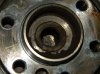
I'm curious if the H3(T) 5M's have a brass or a roller pilot bearing (?). Anyone know for sure. The roller pilot bearing disintegrated on my '98 Firebird Formula and caused me grief with shifting problems. I replaced all the parts and it's been great since that time.
4speedfunk
Well-Known Member
- Messages
- 4,250
- Location
- Tardville
Pilot bushing (left) or pilot bearing (right)...
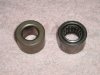
This little guy presses into the end of the crankshaft. The input shaft of the gearbox has a small nub on the end of it, that plugs into this bushing. The bushing is made from soft bronze and they tend to get wollered out over time. This can cause some mis-alignment and "chatter" when releasing the clutch pedal. If your truck vibrates or shudders during slow-release uphill take-offs...this could be the issue. I always replace them with a roller bearing like the one on the right but, there are probably a million opinions on which is better. The roller-type uses hardened steel needle bearings and there is minimal friction, unlike the bronze bushing. The bushing-types wear slowly over time, so they need replacing more often. You can test for wear by inspecting the hole in the center. Most of the time, they will be egg-shaped. You can also use a clutch alignment tool (needed to install your pressure plate/disc kit) to check for excessive slop. I actually use an old input shaft from a Muncie for this. The bearing-type doesn't wear much at all, however they can seize and/or run dry and when they do...they're toast (like Mr_Rich noted). I've re-used the bearing types several times and all I do is add a blob of grease. Regardless...either type needs a pea-sized blob of high-temp grease during installation.
Sometimes you can pull them out of the crank by hand (they should never be this loose). But, most of the time you need a special pilot bushing puller tool...
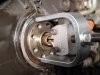
To install the new one, simply tap it into place with a dead-blow or small brass hammer.
You don't always need a new pilot bushing/bearing. Its just something you should be aware of and always check. A worn pilot will eat your new clutch, and it also contributes to input shaft bearing wear inside the gearbox. Its a small, inexpensive part that plays a big roll in clutch engagement...and its buried inside a 4-5 hour job. So, it really is worth your effort to check and replace it if you have any doubts.
This little guy presses into the end of the crankshaft. The input shaft of the gearbox has a small nub on the end of it, that plugs into this bushing. The bushing is made from soft bronze and they tend to get wollered out over time. This can cause some mis-alignment and "chatter" when releasing the clutch pedal. If your truck vibrates or shudders during slow-release uphill take-offs...this could be the issue. I always replace them with a roller bearing like the one on the right but, there are probably a million opinions on which is better. The roller-type uses hardened steel needle bearings and there is minimal friction, unlike the bronze bushing. The bushing-types wear slowly over time, so they need replacing more often. You can test for wear by inspecting the hole in the center. Most of the time, they will be egg-shaped. You can also use a clutch alignment tool (needed to install your pressure plate/disc kit) to check for excessive slop. I actually use an old input shaft from a Muncie for this. The bearing-type doesn't wear much at all, however they can seize and/or run dry and when they do...they're toast (like Mr_Rich noted). I've re-used the bearing types several times and all I do is add a blob of grease. Regardless...either type needs a pea-sized blob of high-temp grease during installation.
Sometimes you can pull them out of the crank by hand (they should never be this loose). But, most of the time you need a special pilot bushing puller tool...
To install the new one, simply tap it into place with a dead-blow or small brass hammer.
You don't always need a new pilot bushing/bearing. Its just something you should be aware of and always check. A worn pilot will eat your new clutch, and it also contributes to input shaft bearing wear inside the gearbox. Its a small, inexpensive part that plays a big roll in clutch engagement...and its buried inside a 4-5 hour job. So, it really is worth your effort to check and replace it if you have any doubts.