There should be zero "play" in the driveshaft....ANY driveshaft! Its a rigid piece and should not have any play whatsoever to it. If it does...its most likely a smoked u-joint or CV-joint.
I'm guessin you are actually referring to "back-lash". Lash is the clearance (or play) between the teeth...either inside the T-case or inside the front axle. Lash exists on all rotating meshing parts, and many times it is needed to allow for the expansion that occurs when parts heat up. In the case of a typical ring & pinion...if you assembled it with zero lash, it would wear-out almost immediately. Lash is your friend, and don't be too concerned if you feel some gear lash when you rock the yoke back & forth. Same is true for the t-case (except its probably "chain lash" instead of "gear lash"). Excessive lash is of course...a huge problem. It can cause whining, bearing failure, premature gear wear, and a host of other problems. Chances are you are simply feeling some normal lash. Lash increases with age and mileage, so as a diff gets over 100K miles on it...the lash can be more than desirable.
When you feel the back-lash via the yoke with your hand (or by grabbing the driveshaft)...it is amplified by the larger diameter. This makes it seem worse than what it actually is. Once you measure it at the teeth, you'll be pleasantly surprised that its probably much less than the 1/2" you are seeing at the shaft. You can check lash with a dial-indicator and magnetic base. Its an easy procedure and it can be done with just the cover removed....
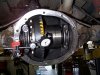
You should shoot for .008" to .012" with variance of not more than .004". GM is rather lax on this number, and I'm sure there are millions of diffs driving around out there with more than this.
The t-case is a totally different critter as it has a chain connecting the rotating parts. Chain stretch will increase with age and mileage, and give you a similar situation. The end result looks the same at the driveshaft. I'm sure there is a way to measure chain stretch and chain lash but, I've never done it. Usually if the chain has more than a certain amount of slack...it gets replaced. I've done this numerous times with timing chains (on the front of motors) but never with a t-case chain. Several forum members have had their H3 t-case chains replaced...so I'm sure its a fairly common issue. H3's have notoriously loose and lashy drivetrains, and this is amplified further in low range.


 . .


