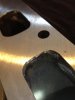
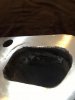
Mostly flat and yes crack free. I would hope they would be. They are brand new.
I was concerned with the flange not being connected with enough of a bead to have the port be flush with the rest of the flange. They didn’t machine the flange flat. It was done with a belt sander. That being said they have skills with a belt sander. However where the flange and the ports meet there are several inconstancies in lack of material ie the top picture that gouge is at least 25-50 thousands deep. There are those "valleys" in the flange on nearly every port-flange connection. That is not good on a gasket as of course, there are high heat gasses moving rapidly that will make their way in those holes which will only weaken the gasket and cause premature failure. Weakness and inconsistencies aren't what I was looking for in an aftermarket part. As most everyone knows the header/manifold gets a lot of abuse as it directs a lot of heat and pressure to where it needs to go.
This being an aftermarket "performance" part. The ports looked like someone made a very feeble attempt to debur them with the side of a drill bit. The chatter marks are absolutely horrible. Even light pressure with your finger and you would easily cut yourself. To note they actually made the steel from the port extend up into the plane of the flange. Again which is supposed to be perfectly flat. Digressing... this being a performance part, I would like to see the ports at least semi uniform. Without jutted steel sticking directly into the flow of exhaust. Uniform somewhat smooth ports would be ideal. The ports on the cast manifold looked infinitely better. I wanted the part for performance increase, as in better exhaust flow, the ports as they were from their shop were any but performance oriented.
I can go on but I will save the rest for the review. Like I said I didn't want to thread jack, just hopefully keep people from throwing their money away. I can't tell everyone how people spend their money though I was just extending my personal experience with that company. I wasn't happy at all with it and the complete lack of give a sh!t attitude when I tried to tell them why it wasn't ok really sealed the deal. When I finally spoke with them I was very professional and cordial. I might have been able to get away with a little bit of a sour attitude after the 4 week delay beyond what I was quoted and not receiving all the products. The adage of you attract more bees with honey than vinegar comes to mind when I am working with other businesses. I let them know I wasn't happy. I was nice about it. He said I don't believe you send me a picture. Very very poor business practices.
Either way again just sharing my experience with them. If anyone else here wants to chance their money with them hoping for a better product my feelings will not be hurt at all.
:rant:
I build headers, and make pretty good side-job money doing so... in the interest of saving this thread, I think we're going to have to agree to disagree.
With that said, let's talk about headers and what to look for in a quality header.
You don't want smooth flanges because the gasket won't seal (ask anyone with chromed headers about this issue).
As long as the header port is larger than the exhaust port, you won't have flow impediment.
Deburring, yep, I agree with you there - however, keep in mind, all headers will eventually crack at the weld; so you want as much material as you can possibly leave there - so I don't think they should have touched it. after all, when you build the headers, as long as you can read a tape measure, it's pretty easy to leave a 1/16" step to allow movement in the manufacturing process. As for cutting your finger? hopefully, once you install the headers, you'll never touch it again (presuming you use proper gaskets like Percy's). Having a surface of .030 milling is correct, actually, because you do not want the header flange to move on the head. Because the bolts for the manifold aren't always a tight tolerance, there will always be so movement allowed with mechanical fasteners - which is why, once you're done with building the headers, you take .005-.010 off to make the flange flat around the tube and leave a rough surface to allow the flange to mechanically attach to the head via the abrasion.
Headers don't make power by smoothing flow - they make power by scavenging. The longer the tube, the better the scavenging. Exhaust manifolds fall before headers because with a longer tube, you even the pulses and create a vacuum when the exhaust valve closes. That vacuum then draws the mixture out again when the exhaust valve opens. Level of vacuum is directly correlated to length of tube - the longer the tube the greater vacuum because of the weight of the air in the tube). Tube sizing is what then becomes important (which is why a larger tube isn't necessarily better).
You did make me laugh at the 5.5 or whatever weeks to complete. When you drop your car off at my shop, I tell you it will be at least 8 weeks to have custom headers done... most times I get it done in that amount of time.
So now that we've dispensed of that - how did the header fit? (I presume it's a 5 cylinder because V8 ports are round, as are the headers)... did you have to do any clearancing?